


2026 Right Whale Festival and Right Whale Week
October 21, 2026Every fall, Fernandina Beach starts looking for winter visitors. Some arrive to rented condos, some arrive in RVs, and some arrive to their second home via the Atlantic Ocean and may weigh up to 140,000 pounds. One of the most fascinating visitors to Amelia Island is the North Atlantic right whale, one of the most endangered marine mammals on the planet. The 2026 Right Whale Festival and Right Whale Week combines education, conservation, family fun, local business specials, live entertainment, food, art, and community spirit into one whale-sized celebration.
 Whether you’re a lifelong local, a visitor looking for a unique coastal experience, or someone who simply enjoys festivals with good food and fewer arguments than Thanksgiving dinner, the 2026 Right Whale Festival and Right Whale Week belongs on your calendar.
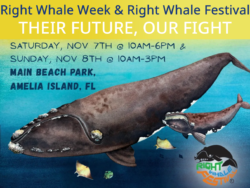
When is the 2026 Right Whale Festival & Right Whale Week?
Right Whale week runs October 20th through November 8th, with the event culminating into one huge weekend festival at Main Beach Park in Fernandina Beach.
Here are the hours:
Saturday, November 7, 2026 10 a.m. to 6 p.m.
Sunday, November 8, 2026 10 a.m. to 3 p.m.
Admission is FREE
- Ocean-themed exhibits
Interactive educational displays
Live music
Food trucks
Arts and crafts vendors
Whale conservation activities
Athletic events
Gifts and locally made products
Family-friendly entertainment
The festival serves as both a celebration and a reminder that these incredible animals still need our help.
What Is Right Whale Week?
While the festival takes place over one weekend, Right Whale Week 2026 runs from October 30 through November 8. Local businesses across Amelia Island and Fernandina Beach participate with whale-themed promotions, special menu items, educational displays, merchandise, and events. Keep an eye out for the official “Sign of the Whale” window decals. They identify participating businesses and make it easy to join the fun while supporting local merchants. You may discover whale-themed cocktails, whale-shaped cookies, special retail discounts, educational posters, creative displays, or even the blog you’re reading right now.
Fernandina folks can turn almost anything into a reason to celebrate! And honestly, we’re pretty good at it.
Right Whale Nurseries
The star of the 2026 Right Whale Festival and Right Whale Week is the North Atlantic right whale, one of the world’s most endangered large whale species. There are three species of right whales worldwide:
- North Atlantic right whale
North Pacific right whale
Southern right whale
Our coastal waters play a particularly important role for the North Atlantic population. Each winter, pregnant females migrate south to the warmer waters off Georgia and Florida to give birth. The waters off Northeast Florida are considered part of the whales’ critical calving habitat, making Amelia Island one of the few places in the world where these remarkable animals can occasionally be spotted close to shore.
In other words, while tourists come here for sunshine and shrimp, the whales come here for maternity leave.
The Incredible Life of a Right Whale
Right whales are baleen whales, meaning they don’t have teeth. Instead, they use specialized baleen plates to filter tiny crustaceans called copepods from enormous volumes of seawater.
Some fascinating facts you’ll learn during the 2026 Right Whale Festival & Right Whale Week include:
- Calves are about 14 feet long at birth.
Adults can grow to more than 50 feet long.
They can weigh up to 70 tons.
Every whale has a unique pattern of callosities on its head, allowing researchers to identify individual animals.
Mothers and calves spend months together in southeastern waters before beginning their migration north.
Scientists often describe these whales as gentle giants, although a 50-foot animal crashing back into the ocean during a breach is probably only gentle by whale standards.
How Did They Get Such a Terrible Name?
The story behind the name isn’t exactly one of humanity’s proudest moments. Right whales were once considered the “right whale to hunt” because they swam slowly, stayed close to shore, contained large amounts of valuable oil, and floated when killed. Commercial whaling nearly wiped them out. By the late 1800s, North Atlantic right whales had been hunted to the brink of extinction. Although commercial whaling is no longer a threat, the species has never recovered to historical population levels. Today, fewer than 500 North Atlantic right whales remain.
That’s one of the major reasons the 2026 Right Whale Festival & Right Whale Week exists: to raise awareness and inspire conservation.
The challenges right whales face today include modern threats that look very different from those faced a century ago. The biggest dangers to North Atlantic right whales now include:
- Vessel Strikes – Large ships and recreational boats can accidentally collide with whales, causing severe injuries or death.
Fishing Gear Entanglement – Lines and nets can become wrapped around whales, affecting their ability to swim, feed, and reproduce.
Ocean Noise – Increasing underwater noise from human activity, such as drilling and offshore wind farms, can interfere with whale communication and create additional stress.
Climate Variability – Climate variability and ocean conditions are already reshaping right whale habitats and food availability, creating new challenges for recovery. This, in turn is forcing changes in feeding grounds, migration timing, and the population’s health. These effects are well-documented in the Gulf of Maine and surrounding regions, and they require adaptive conservation strategies to protect this critically endangered species. Despite decades of protection, recovering such a small population remains a significant challenge.
Why Florida Waters Are So Important
One reason the 2026 Right Whale Festival & Right Whale Week is so important to us is because the waters along Florida’s Atlantic coast serve as essential habitat for mothers and calves. Research has shown that mother-calf pairs consistently use portions of Florida’s coastline during the calving season. These calmer, warmer waters provide an important environment for nursing, resting, and helping young calves gain strength before their long migration north. If you’ve ever wondered why Amelia Island celebrates right whales so passionately, that’s your answer.
They aren’t just visitors. They’re neighbors.
Make Plans for the 2026 Right Whale Festival and Right Whale Week
Spend the week exploring participating local businesses. Look for the Sign of the Whale decals. Visit Main Beach Park. Listen to live music. Grab something delicious from a food truck. Learn about one of the rarest whales on Earth.
Most importantly, this is a family friendly event. Conservation starts when curiosity begins, and there’s something magical about seeing a child discover that a creature longer than a school bus swims just offshore from the beaches they know and love. This is a celebration of our coast, our community, and a species fighting for survival. And if we do our part, future generations will still be gathering on Amelia Island every fall to welcome these extraordinary giants back home.
Come for the festival. Stay for the whales. Leave knowing a little more than you did before. And maybe with a coastal or whale-themed souvenir made by local hands for a great cause!
Tags: WildlifeCategorised in: Cruises & Events, Wildlife & Marine Biology
